Best Crypto Exchange – Compare Top-Rated Platforms for Secure Trading

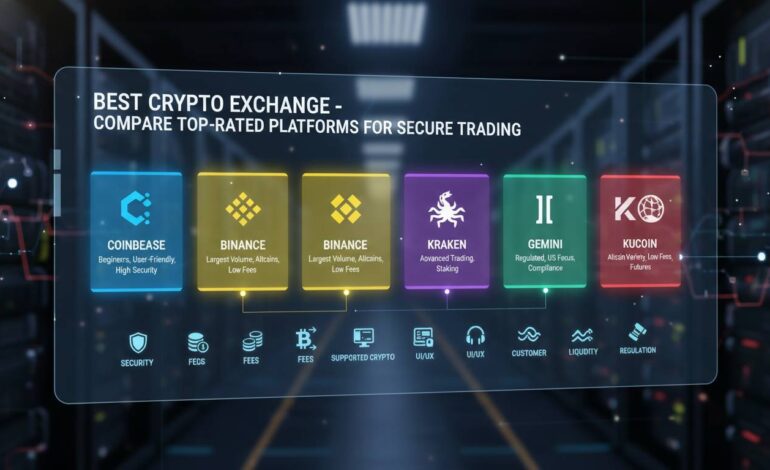
The best crypto exchange for you depends on your experience level, trading goals, and security priorities. For most US-based investors, Coinbase offers the best balance of security, usability, and regulatory compliance, while Binance and Kraken cater to advanced traders seeking lower fees and more features. This guide compares the top platforms, analyzes fees, security features, and helps you choose the right exchange for your needs.
📊 STATS
• 91 million users worldwide actively trade on crypto exchanges
• $2.3 trillion in quarterly crypto trading volume occurs on centralized exchanges
• 67% of crypto investors cite security as their primary concern when choosing an exchange
• $4.2 billion in crypto was stolen from exchanges in 2022, highlighting security importance
Key Takeaways
• Coinbase leads in US regulatory compliance and beginner-friendly interface
• Kraken offers the lowest fees for high-volume traders (0-0.26% maker-taker)
• Binance provides the widest selection of cryptocurrencies (350+)
• Gemini excels in security and regulatory standing for US users
• Hardware wallets remain the safest storage method regardless of exchange choice
• SEC regulations in 2024 continue shaping which exchanges serve US customers
Understanding Crypto Exchanges
A cryptocurrency exchange is a digital platform that allows you to buy, sell, and trade cryptocurrencies like Bitcoin, Ethereum, and thousands of altcoins. These platforms act as intermediaries, matching buy and sell orders while charging fees for their services.
Centralized exchanges (CEXs) like Coinbase and Binance operate as traditional financial institutions, holding user funds and managing order books. They offer higher liquidity, better price execution, and customer support but require you to trust the platform with your assets. Decentralized exchanges (DEXs) like Uniswap operate without intermediaries, giving you full control of your funds but typically offering less liquidity and more complexity.
For US-based traders, regulatory compliance represents a critical distinction. The Securities and Exchange Commission (SEC) has increased scrutiny of crypto platforms since 2023, leading several exchanges to restrict certain services for American users. Choosing a properly licensed US exchange protects you from regulatory complications and provides legal recourse if issues arise.
Types of Crypto Exchanges
Centralized Exchanges (CEX): These platforms hold your funds and execute trades on your behalf. They offer intuitive interfaces, customer support, fiat on-ramps, and advanced trading features. Examples include Coinbase, Binance.US, Kraken, and Gemini. CEXs are ideal for beginners and intermediate traders who want convenience and support.
Decentralized Exchanges (DEX): These peer-to-peer platforms run on blockchain smart contracts, eliminating the need for intermediaries. Uniswap, Curve, and PancakeSwap fall into this category. DEXs provide greater privacy and control but require more technical knowledge and typically have higher slippage on large orders.
Hybrid Exchanges: Some platforms combine features of both, offering self-custody options with CEX-like interfaces. These represent an emerging category aiming to balance security and convenience.
💡 STAT: 73% of crypto traders use centralized exchanges as their primary trading venue, valuing convenience over full decentralization
How Crypto Exchange Fees Work
Understanding fee structures prevents unexpected costs. Most exchanges charge maker fees (when you add liquidity to the order book) and taker fees (when you remove liquidity). Fees typically range from 0.1% to 1% per trade, with volume discounts available. Withdrawal fees vary by cryptocurrency and network conditions.
Top Crypto Exchanges Compared
| Factor | Coinbase | Binance.US | Kraken | Gemini |
|---|---|---|---|---|
| Best For | Beginners, Security | Low fees, Variety | Pro traders | Regulated trust |
| Trading Fees | 0.6% – 2.4% | 0.1% – 0.6% | 0% – 0.26% | 0.35% – 0.25% |
| Cryptos Available | 200+ | 350+ | 200+ | 100+ |
| US Regulated | ✅ Yes | ✅ Yes | ✅ Yes | ✅ Yes |
| Mobile App | ⭐⭐⭐⭐⭐ | ⭐⭐⭐⭐ | ⭐⭐⭐⭐ | ⭐⭐⭐⭐ |
| Customer Support | Good | Limited | Good | Excellent |
Coinbase – Best Overall for US Users
✅ Pros:
• Fully licensed in 49 US states with regulatory compliance
• Industry-leading security features including cold storage for 98% of funds
• FDIC insurance up to $250,000 for USD balances
• Intuitive interface ideal for beginners
• Strong mobile app with 4.8-star rating on iOS
❌ Cons:
• Higher fees compared to competitors (up to 2.4% for small transactions)
• Limited advanced trading features on basic platform
• Customer support response times can be slow during high traffic
💰 Price: Free to start, trading fees 0.6% – 2.4% depending on volume
🎯 For: Beginners, regulatory-conscious investors, first-time crypto buyers
Coinbase went public on NASDAQ in April 2021, becoming the first major US crypto exchange to offer public stock. This transparency and regulatory adherence make it the default choice for US investors concerned about legal compliance. The platform’s Learn rewards program also lets users earn crypto while educational content, making it particularly attractive for newcomers.
Binance.US – Best for Low Fees and Variety
✅ Pros:
• Extremely competitive fee structure (0.1% spot trading)
• Largest selection of cryptocurrencies available in the US (350+)
• Advanced charting and trading tools
• Strong liquidity for major pairs
❌ Cons:
• More limited in certain states (not available in NY, TX, FL in some forms)
• Complex interface can overwhelm beginners
• Past regulatory scrutiny with parent company Binance globally
💰 Price: Trading fees 0.1% – 0.6%, among lowest in industry
🎯 For: Experienced traders seeking variety and low costs
Binance.US operates separately from its global parent company and complies with US regulations. The platform offers significantly lower fees than competitors, making it attractive for frequent traders. However, the complex interface and occasional availability issues in certain states make it less suitable for beginners.
Kraken – Best for Advanced Traders
✅ Pros:
• Lowest fee structure for high-volume traders (0% maker fees for large volumes)
• Extensive advanced order types (limit, market, stop-loss, trailing stop)
• Staking options with competitive yields
• Strong security track record with no major hacks
❌ Cons:
• Interface can be confusing for beginners
• Limited fiat currency options compared to Coinbase
• Verification process takes longer than competitors
💰 Price: 0% – 0.26% maker-taker fees based on volume
🎯 For: Active traders, those seeking staking rewards, security-conscious users
Kraken has operated since 2013 without major security breaches, a remarkable achievement in the crypto space. The platform offers sophisticated trading features including futures and margin trading for eligible users. Professional traders benefit from the low fees at higher volume tiers.
Gemini – Best for Security and Trust
✅ Pros:
• Highest regulatory compliance standards in the US
• SOC 2 Type II certified security
• Excellent customer service and insurance coverage
• User-friendly Earn program for passive income
❌ Cons:
• Higher fees than some competitors
• Fewer cryptocurrency options than larger exchanges
• Limited advanced trading features
💰 Price: 0.35% – 0.25% depending on volume
🎯 For: Security-first investors, institutional users, conservative traders
Gemini was founded by the Winklevoss twins and operates with a strong focus on regulatory compliance. The exchange maintains full reserve proof through monthly audits and offers FDIC insurance for USD deposits. For users prioritizing security and regulatory clarity over fee savings, Gemini stands out.
Features to Consider When Choosing
Security Features
Security should be your primary concern when selecting a crypto exchange. Look for platforms offering two-factor authentication (2FA), cold storage for the majority of funds, withdrawal whitelisting, and anti-phishing measures. The best exchanges maintain insurance funds to protect users against theft and provide clear incident response protocols.
Kraken has never been successfully hacked in over a decade of operation. Coinbase stores 98% of customer funds in offline cold storage and maintains crime insurance coverage. Gemini goes further with monthly reserve proofs and SOC 2 Type II certification, providing institutional-grade security assurances.
Supported Cryptocurrencies
Your investment strategy determines how many cryptocurrencies you need access to. If you only plan to buy Bitcoin and Ethereum, most exchanges serve you well. However, if you want exposure to emerging altcoins, Binance.US offers 350+ options while Gemini provides only 100+.
Consider whether the exchange supports the specific tokens you want before signing up. Some platforms restrict certain tokens in specific states due to regulatory uncertainty.
Payment Methods and Fiat Support
US users need easy ways to convert dollars to crypto and vice versa. Coinbase, Gemini, and Kraken all support ACH bank transfers, wire transfers, and debit cards. Processing times vary from instant (debit cards) to several days (ACH transfers).
Check whether your preferred exchange supports instant withdrawals to your bank account, as this affects how quickly you can access funds.
Trading Features and Tools
Beginner-friendly platforms like Coinbase offer simple buy/sell interfaces with market orders only. Advanced traders need access to limit orders, stop-losses, margin trading, and futures. Kraken and Binance.US provide sophisticated charting with TradingView integration.
Consider whether you need features like staking (earning rewards by holding certain cryptocurrencies), crypto loans, or NFT marketplaces, as availability varies significantly.
How to Get Started with a Crypto Exchange
Prerequisites:
– [ ] Valid government-issued ID for identity verification
– [ ] Bank account or debit card for funding
– [ ] Secure email with 2FA enabled
– [ ] Understanding of basic cryptocurrency concepts
– [ ] Investment goals and risk tolerance defined
Time: 15-30 minutes | Cost: $0 – Variable based on trading
Steps
1. Create Your Account
Visit your chosen exchange and click sign up. You’ll need to provide your email, create a password meeting security requirements, and verify your email address. Enable two-factor authentication immediately using an authenticator app rather than SMS.
⏱ 5 minutes | 💡 Tip: Use a password manager to generate a strong, unique password
2. Complete Identity Verification (KYC)
US exchanges require Know Your Customer (KYC) compliance. Upload a clear photo of your government-issued ID and provide personal information including Social Security Number. Verification typically completes within minutes but can take longer during high demand.
⚠️ Avoid: Using a VPN during verification → Fix: Use standard internet connection to prevent account flags
3. Fund Your Account
Link your bank account via ACH for free transfers (3-5 business days) or use a debit card for instant funding (3-5% fee). Wire transfers work for large amounts but have minimums and processing delays.
4. Make Your First Purchase
Start with a small amount to test the process. Select your desired cryptocurrency, enter the amount, and review the order. Coinbase and similar platforms show fee breakdowns before confirmation.
5. Secure Your Assets
For long-term holdings, transfer crypto to a personal hardware wallet. Only keep trading funds on the exchange. Enable all available security features including withdrawal address whitelisting.
Troubleshooting:
| Problem | Fix |
|———|—–|
| ID verification failed | Ensure good lighting, clear image, matches legal name exactly |
| Bank transfer pending | Contact bank; some block crypto transfers initially |
| Can’t withdraw funds | Complete full verification; check for holds or restrictions |
| Account locked | Contact support with verification documents; avoid multiple attempts |
Common Mistakes to Avoid
| Mistake | Impact | Solution |
|---|---|---|
| Storing crypto on exchange | 📉 Full loss if hacked | Use hardware wallet for holdings over $1,000 |
| Ignoring fee structures | 📉 2-3x higher trading costs | Use limit orders and fee discounts |
| Not enabling 2FA | 📉 Full account vulnerability | Enable authenticator app immediately |
| Chasing pumps | 📉 Significant financial losses | Research before investing; don’t FOMO |
| Ignoring tax implications | 📉 Penalties and audits | Use crypto tax software; maintain records |
⚠️ CRITICAL: Leaving large amounts on exchange hot wallets represents the biggest risk. The 2022 collapse of FTX demonstrated that even major, regulated-seeming exchanges can fail. Prevent: Withdraw holdings to personal hardware wallets (Ledger, Trezor) for any funds you don’t actively trade.
Expert Insights
👤 Michael Saylor, CEO of MicroStrategy
“Hold your own keys or don’t hold crypto at all. The greatest risk in cryptocurrency is counterparty risk—the risk that whoever holds your keys will fail, get hacked, or freeze your assets.”
Data: MicroStrategy holds over 200,000 Bitcoin on corporate balance sheet
👤 Vitalik Buterin, Ethereum Founder
“Wallets should be designed to make it easy to do the right thing and hard to do the wrong thing.”
Advice: Choose exchanges that prioritize user security and education
📊 BENCHMARKS
| Metric | Average Exchange | Top 10% |
|——–|——————|———|
| Cold Storage % | 70% | 95%+ |
| Fee (retail trader) | 1.2% | 0.25% |
| Verification time | 24 hours | Under 10 minutes |
| Uptime | 99.5% | 99.99% |
Tools and Resources
| Tool | Cost | For | Rating |
|---|---|---|---|
| CoinGecko | Free | Price tracking, portfolio | ⭐⭐⭐⭐⭐ |
| CoinMarketCap | Free | Market data, rankings | ⭐⭐⭐⭐⭐ |
| CryptoTaxCalculator | $49-299 | Tax reporting | ⭐⭐⭐⭐ |
| Ledger Wallet | $79+ | Secure storage | ⭐⭐⭐⭐⭐ |
| Trezor | $59+ | Secure storage | ⭐⭐⭐⭐⭐ |
Top Picks:
• CoinGecko: Best overall for price tracking with trustworthy volume data
• Ledger: Industry-leading hardware wallet with broad coin support
• CryptoTaxCalculator: Simplifies IRS reporting requirements
Frequently Asked Questions
Which crypto exchange is best for beginners in 2024?
Coinbase remains the best choice for beginners due to its intuitive interface, educational resources, and strong regulatory compliance. The platform guides new users through purchasing their first cryptocurrency with clear explanations and minimal complexity. Robinhood also appeals to beginners but offers fewer cryptocurrencies and can’t transfer coins off-platform.
What is the safest crypto exchange in the US?
Gemini and Kraken rank among the safest US exchanges. Gemini maintains SOC 2 Type II certification, monthly reserve proofs, and full FDIC insurance for USD balances. Kraken has operated for over a decade without a successful hack and offers robust security features. However, the safest approach combines reputable exchanges with personal hardware wallets for significant holdings.
How much money do I need to start trading crypto?
You can start with as little as $1-2 on most exchanges. Coinbase allows purchases starting at $2. However, consider transaction fees as a percentage—trading $10 with a 2% fee costs $0.20, while trading $1,000 costs $20. Larger initial investments make fee percentages more manageable.
Are crypto exchanges legal in the United States?
Yes, crypto exchanges operate legally in the US but must comply with federal and state regulations. Licensed exchanges must register as Money Services Businesses (MSBs) with FinCEN and comply with state money transmitter laws. Some states like New York require specific BitLicense approvals. Using properly licensed US exchanges ensures legal protection and regulatory recourse.
Can I transfer crypto between exchanges?
Yes, you can transfer cryptocurrency between any compatible blockchain addresses. Ensure both exchanges support the specific token and use the correct deposit address. Always test with a small amount first, as sending to wrong addresses results in permanent loss. Cross-exchange transfers incur network fees but no exchange fees.
Which crypto exchange has the lowest fees?
Binance.US and Kraken offer the lowest fees for US users. Binance.US charges 0.1% to 0.6% for spot trading while Kraken’s fees range from 0% to 0.26% depending on volume. Coinbase charges higher fees (0.6% to 2.4%) but provides better support and simpler interfaces. Consider all fees including withdrawal and conversion costs when comparing.
Conclusion
Choosing the best crypto exchange requires balancing security, fees, features, and regulatory compliance. For most US users, Coinbase provides the optimal starting point with its combination of beginner-friendly design, regulatory compliance, and strong security. As your experience grows, you might maintain accounts with multiple exchanges—using Coinbase for fiat on-ramps, Kraken for low-fee trading, and a hardware wallet for secure storage.
The most critical decision isn’t which exchange to use but how you store your assets. Regardless of platform choice, withdraw significant holdings to personal hardware wallets. The crypto industry continues evolving rapidly, with regulatory changes potentially affecting platform availability. Stay informed, prioritize security, and never invest more than you can afford to lose.
Your perfect exchange depends on your specific needs: choose Coinbase for ease of use, Binance.US for variety and low costs, Kraken for professional trading features, or Gemini for maximum security and trust. Start with one platform, learn the process, and expand your strategy as confidence grows.