Best Altcoins to Invest in Long Term: Expert Picks to 10x Your Portfolio

The cryptocurrency market presents compelling opportunities for long-term investors willing to navigate its volatility. While Bitcoin remains the dominant digital asset, thousands of alternative cryptocurrencies—known as altcoins—offer diverse investment possibilities with varying risk profiles and use cases.
Key Insights
– The altcoin market encompasses thousands of tokens serving different purposes: smart contracts, DeFi, NFTs, and enterprise solutions
– Long-term altcoin investment requires understanding tokenomics, team credibility, and real-world utility
– Portfolio diversification across different altcoin categories reduces overall risk exposure
– Regulatory developments significantly impact altcoin valuations and investment viability
This comprehensive guide examines the fundamentals of altcoin investing, evaluates promising projects, and provides strategic frameworks for building a resilient long-term cryptocurrency portfolio.
Understanding the Altcoin Landscape
The term “altcoin” refers to any cryptocurrency other than Bitcoin. Since the launch of Namecoin in 2011, the crypto ecosystem has grown to include over 14,000 different tokens, each serving distinct functions within the blockchain economy.
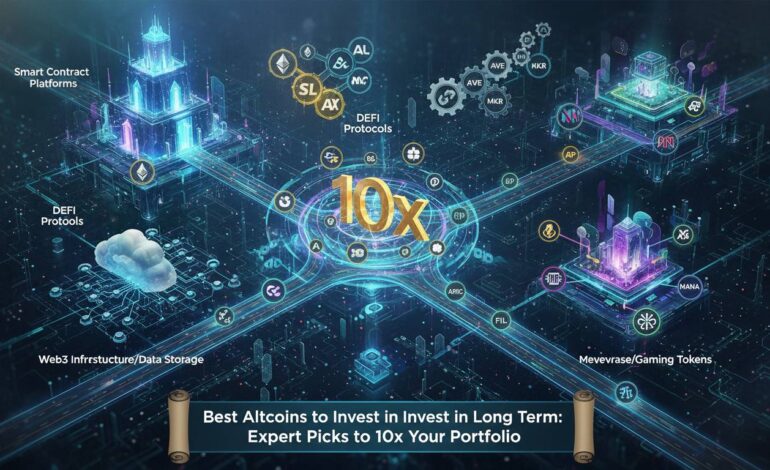
Altcoins generally fall into several categories based on their primary use case. Ethereum-compatible tokens operate on the Ethereum network and include standards like ERC-20. Smart contract platforms like Solana, Cardano, and Avalanche enable decentralized applications. DeFi tokens power decentralized finance protocols including lending, borrowing, and trading platforms. Utility tokens provide access to specific products or services within a blockchain ecosystem.
The market capitalization of altcoins combined exceeds $500 billion, representing significant capital allocation from investors worldwide. However, this figure fluctuates dramatically based on market sentiment, regulatory announcements, and technological developments.
Market Distribution
| Category | Representative Tokens | Market Role |
|———-|———————-|————-|
| Smart Contracts | ETH, SOL, ADA, AVAX | Infrastructure for dApps |
| DeFi | UNI, AAVE, LINK | Financial services |
| Layer 2 Solutions | MATIC, ARB, OP | Scaling Ethereum |
| Gaming/NFT | AXS, SAND, MANA | Digital ownership |
Understanding these categories helps investors make informed decisions aligned with their risk tolerance and investment thesis.
Evaluating Altcoins for Long-Term Investment
Successful altcoin investing requires rigorous evaluation across multiple dimensions. Unlike stocks, cryptocurrency projects lack standardized financial reporting, making due diligence critical.
Tokenomics Analysis
Tokenomics encompasses the economic design of a cryptocurrency, including its supply mechanics, distribution model, and incentive structures. Investors should examine whether tokens have fixed supplies or inflationary mechanisms, as scarcity often influences value appreciation.
The distribution of tokens significantly impacts investment risk. Projects with large allocations to venture capital firms or founding teams may face selling pressure when unlock periods expire. Conversely, well-designed tokenomics with community-focused distribution can create sustainable value accrual mechanisms.
Look for tokens with clear utility within their ecosystems—whether for governance rights, staking rewards, or transaction fee payments. Tokens serving functional purposes within growing platforms tend to maintain value better than those lacking real-world utility.
Team and Development Assessment
The credibility and track record of development teams substantially influence project success. Evaluate whether teams have demonstrated technical expertise through consistent code commits, transparent communication, and achievement of roadmap milestones.
Open-source development allows independent verification of project progress. Active GitHub repositories with regular commits indicate ongoing development rather than abandoned projects. Community engagement through Discord, forums, and social media provides insights into project health and team responsiveness.
Partnership announcements with established enterprises or other blockchain projects can validate technical claims and expand use case possibilities. However, investors should verify partnerships independently, as false or exaggerated announcements occasionally surface.
Technology and Use Case Evaluation
The fundamental value proposition of any altcoin rests on its technological differentiation and practical applications. Assess whether projects solve genuine problems or offer meaningful improvements over existing solutions.
Scalability remains a critical challenge for blockchain networks. Evaluate whether projects address throughput limitations through innovative consensus mechanisms, sharding solutions, or layer 2 architectures. Network performance metrics including transaction speed, finality times, and gas fees directly impact user experience and adoption potential.
Real-world adoption provides tangible validation of utility claims. Projects with established user bases, transaction volumes, and integration partnerships demonstrate market fit beyond speculative trading.
Top Altcoin Categories for Long-Term Portfolios
Strategic altcoin investment involves balancing potential returns against associated risks through diversification across categories.
Smart Contract Platforms
Smart contract platforms form the infrastructure for decentralized applications and represent foundational positions within the crypto ecosystem.
Ethereum (ETH) maintains dominance as the most widely-used smart contract platform, hosting the majority of DeFi protocols and NFT marketplaces. The transition to proof-of-stake has reduced energy consumption by approximately 99.95% while creating staking yield opportunities for holders. Network effects and developer activity provide significant competitive advantages despite higher transaction costs compared to newer blockchains.
Solana (SOL) offers high throughput with lower fees, attracting users and developers seeking alternatives to Ethereum’s congestion issues. The ecosystem has recovered from previous network outages, demonstrating improved stability. SOL’s inflationary tokenomics differ from deflationary designs, requiring consideration in investment analysis.
Avalanche (AVAX) distinguishes through its unique consensus mechanism enabling fast finality and high throughput. The subnet architecture allows developers to create customized blockchain networks, attracting enterprise and institutional interest.
Decentralized Finance (DeFi)
DeFi protocols recreate traditional financial services without intermediaries, offering yield generation and trading opportunities.
Uniswap (UNI) operates as the leading decentralized exchange by volume, enabling permissionless token swaps. The protocol’s governance token provides voting rights on protocol upgrades and fee distributions, creating value accrual for holders.
Aave (AAVE) leads the decentralized lending market, allowing users to supply assets for interest or borrow against collateral. The protocol’s track record of security audits and conservative risk management has built trust within the community.
Chainlink (LINK) provides oracle services connecting smart contracts with real-world data, essential for DeFi insurance, betting platforms, and asset price feeds. The network effect around Chainlink’s data quality creates meaningful competitive barriers.
Layer 2 Scaling Solutions
Layer 2 technologies extend Ethereum’s capabilities while maintaining security guarantees.
Polygon (MATIC) has established itself as a major scaling solution, processing transactions at lower costs than Ethereum mainnet. The acquisition of Hermez and zkEVM development demonstrates commitment to long-term scaling solutions.
Arbitrum and Optimism utilize optimistic rollup technology to batch transactions off-chain while maintaining Ethereum security. Both have launched governance tokens following community airdrops, creating engagement incentives.
Risk Factors in Altcoin Investing
Long-term altcoin investment requires understanding and managing substantial risks inherent to the asset class.
Volatility and Market Risk
Cryptocurrency markets exhibit extreme volatility, with altcoins often experiencing daily moves of 10-20%. This volatility stems from relatively thin trading volumes, speculative trading dominance, and sensitivity to social media sentiment. Long-term investors must maintain conviction through drawdowns that would trigger stop-losses in traditional markets.
Market correlation with Bitcoin remains significant, meaning altcoin portfolios often decline during Bitcoin bear markets regardless of individual project fundamentals. However, during bull markets, altcoins can significantly outperform Bitcoin’s returns.
Regulatory Uncertainty
Regulatory frameworks for cryptocurrencies remain unsettled across major markets. Potential restrictions on altcoin trading, staking, or DeFi protocols could impact investor returns. The classification of various tokens as securities versus commodities affects listing availability on regulated exchanges.
Recent enforcement actions against specific altcoin projects and exchanges highlight regulatory risks. Investors should monitor developments in key jurisdictions including the United States, European Union, and Singapore.
Technical and Security Risks
Smart contract vulnerabilities have resulted in billions of dollars in losses through exploits. While audits reduce risk, they do not guarantee security. Even established protocols have suffered hacks years after launch, demonstrating ongoing security challenges.
Protocol centralization risks exist even in decentralized systems. Teams may hold administrative keys enabling emergency interventions. Network upgrades can create contentious forks, fragmenting communities and token values.
Investment Strategies for Altcoin Portfolios
Developing a systematic approach improves outcomes in the speculative altcoin market.
Portfolio Construction
Diversification across altcoin categories reduces single-point failures while maintaining exposure to potential winners. A tiered allocation model considers risk tolerance: core positions in established tokens, satellite positions in mid-cap projects, and small allocations to higher-risk early-stage opportunities.
Position sizing matters significantly. Even conviction picks should remain manageable percentages of total portfolio value. The reality of altcoin investing includes projects failing entirely or declining 90% or more from peaks.
Dollar-cost averaging reduces timing risk by accumulating positions over time rather than single purchases. This approach works particularly well in volatile crypto markets where entries at various prices smooth average costs.
Research Process
Fundamental research should precede any investment decision. Start by examining whitepapers to understand token economics, use cases, and technical architecture. Evaluate team backgrounds through LinkedIn and previous project history.
Community analysis reveals project health. Discord and Telegram activity indicate engaged users. Twitter following and sentiment provide market perception insights. However, coordinated shilling and artificial enthusiasm exist, requiring critical evaluation.
Track development activity through GitHub commits and developer documentation. Projects with consistent progress toward stated milestones demonstrate执行力 differentiating them from paper projects.
Exit Strategies
Successful investing requires defined exit criteria. Establish take-profit levels based on reasonable expectations rather than speculative dreams. Consider taking partial profits at meaningful gains to secure returns while maintaining exposure to further upside.
Stop-loss disciplines prevent catastrophic losses in falling markets. While crypto volatility may trigger stop-losses prematurely, they provide protection against 80-90% declines that altcoins frequently experience.
Future Outlook for Altcoin Investment
The altcoin market continues evolving with technological advancement and institutional adoption.
Interoperability between blockchains improves through cross-chain bridges and layer 0 protocols. This connectivity expands use cases while creating compounding network effects for dominant platforms.
Institutional engagement increases through regulated vehicles and custody solutions. While this development brings capital and legitimacy, it also introduces traditional market correlations and potentially stricter regulatory scrutiny.
The convergence of artificial intelligence and blockchain creates emerging opportunities. Projects combining AI services with decentralized infrastructure represent a developing category attracting investor attention.
Frequently Asked Questions
How much of my portfolio should I allocate to altcoins?
Financial advisors typically recommend limiting cryptocurrency allocations to 5-10% of total portfolios due to volatility. Within crypto allocations, altcoin positions depend on risk tolerance—conservative investors might allocate 20-30% to altcoins versus 70-80% to Bitcoin and Ethereum, while aggressive investors may accept 50%+ altcoin exposure.
Are altcoins riskier than Bitcoin?
Yes, altcoins generally carry higher risk than Bitcoin due to lower liquidity, smaller market caps, and higher failure rates. While Bitcoin has established itself as digital gold with institutional adoption, most altcoins lack comparable recognition or utility. The majority of altcoins launched in any given year eventually become worthless or abandoned.
When is the best time to buy altcoins for long-term investment?
Dollar-cost averaging during bear markets historically produced superior long-term returns compared to buying during bull markets. Avoiding FOMO-driven purchases during price spikes reduces entry costs. However, timing markets remains challenging, making consistent accumulation more practical for most investors.
How do I evaluate if an altcoin will succeed long-term?
Key evaluation criteria include: active development demonstrated through code commits, real-world adoption measured by user numbers and transaction volumes, tokenomics that align incentives, credible teams with relevant experience, and competitive differentiation within their category. No guarantee exists, but rigorous analysis improves probability of success.
Should I stake my altcoin holdings?
Staking can provide yield on holdings while supporting network security, but introduces additional complexity and risks. Staked tokens often have lock-up periods preventing immediate sale during market downturns. Research specific token staking mechanisms, slashing risks, and tax implications before participating.
What happens to altcoins if Bitcoin crashes?
Altcoins typically experience amplified declines during Bitcoin bear markets due to reduced liquidity and risk-off sentiment. Correlation between Bitcoin and altcoins increases during market stress. However, altcoins have historically recovered faster and produced larger percentage gains during subsequent bull markets, though past performance does not guarantee future results.
Conclusion
Long-term altcoin investing requires balancing potential returns against substantial risks through informed decision-making and disciplined portfolio management. The cryptocurrency market offers genuine innovation through smart contracts, DeFi, and Web3 technologies, creating investment opportunities beyond Bitcoin.
Successful altcoin investors focus on fundamental analysis rather than speculation, understanding that portfolio growth stems from identifying projects with real utility and sustainable tokenomics. Diversification across categories, dollar-cost averaging, and defined exit strategies provide frameworks for navigating volatility.
Remember that cryptocurrency investing involves substantial risk, and investors should only allocate capital they can afford to lose entirely. Regulatory developments, technological changes, and market dynamics continue evolving, requiring ongoing learning and strategy adaptation.
The most successful long-term altcoin investors combine thorough research with patience, maintaining conviction through market cycles while remaining willing to exit positions that no longer meet investment thesis criteria.