How to Avoid Crypto Scams: Complete Beginner’s Guide

Cryptocurrency has transformed finance, offering unprecedented opportunities for wealth creation. Yet this transformative potential comes with significant risks. In 2023 alone, crypto investors lost over $1.7 billion to scams and fraudulent schemes, according to the FBI’s Internet Crime Report. For beginners entering this exciting but complex market, understanding how to protect yourself isn’t optional—it’s essential.
This guide walks you through everything you need to know to identify, avoid, and respond to crypto scams. Whether you’re planning your first purchase or looking to strengthen your security knowledge, these strategies will help you navigate the crypto landscape with confidence.
The Crypto Scam Landscape: Why Beginners Are Targets
The cryptocurrency market attracts scammers for three interconnected reasons: high valuations create tempting targets, the technology remains confusing to newcomers, and transaction irreversibility means mistakes become permanent instantly.
Key Statistics
– Crypto scam losses exceeded $1.7 billion in 2023 (FBI Internet Crime Report)
– Investment fraud accounted for 71% of all crypto-related losses (Federal Trade Commission)
– The average victim loses approximately $3,000 to crypto investment scams (Better Business Bureau)
– Rug pull scams—where developers abandon projects after collecting investor funds—represented 37% of all crypto fraud cases in 2023 (Chainalysis)
Beginners face particular vulnerability because they lack the experience to distinguish legitimate projects from sophisticated cons. Scammers specifically target crypto newcomers through social media, dating apps, and fake investment platforms, exploiting enthusiasm and trust.
The Most Common Types of Crypto Scams
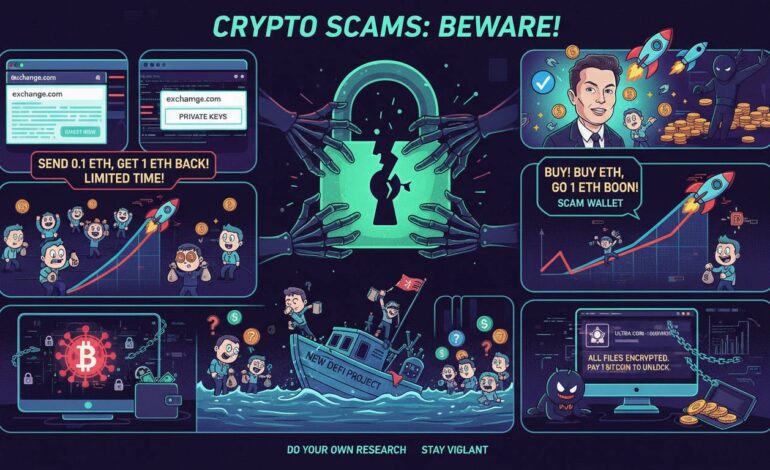
Understanding how scammers operate is your first line of defense. These seven schemes account for the majority of crypto fraud targeting individual investors.
1. Phishing Attacks
Scammers send emails, text messages, or social media messages pretending to be from legitimate exchanges or wallet providers. These messages contain links to fake websites that steal your login credentials. Once attackers access your account, they transfer your funds within seconds.
Real example: In 2022, attackers used Google Ads to create fake versions of the MetaMask wallet login page, stealing credentials from thousands of users who thought they were accessing the legitimate site.
2. Rug Pulls
Developers create cryptocurrency projects, build excitement through marketing and social media presence, then withdraw all investor funds and disappear. The token’s value crashes to zero, leaving investors with worthless holdings that cannot be sold.
Real example: The Squid Game token in 2021 attracted millions in investment before the developers abandoned the project, causing the token to lose 99.9% of its value within minutes.
3. Ponzi and Pyramid Schemes
These platforms promise unrealistic returns—often 1-2% daily—and use money from new investors to pay earlier participants. The structure collapses when recruitment slows, leaving the majority of participants with losses.
Real example: BitConnect, one of the largest crypto Ponzi schemes, collapsed in 2018 after the platform shut down, causing estimated losses exceeding $3.5 billion.
4. Fake Exchanges and Wallets
Scammers create entirely fake cryptocurrency exchanges or wallet apps that appear legitimate. Users deposit funds expecting to trade or store cryptocurrency, but the platform simply collects deposits. Withdrawal requests go unanswered or require additional “verification fees.”
Real example: Several fake crypto exchanges operated in 2023, including platforms that replicated the exact interface of legitimate exchanges like Binance and Coinbase, tricking users into entering credentials.
5. Impersonation Scams
Scammers pose as well-known figures, influencers, or company representatives on social media, offering “exclusive” investment opportunities or giveaways. These accounts often have verified badges and authentic-looking profiles, but any funds sent disappear immediately.
6. Romance Scams
Criminals establish romantic relationships through dating apps and social media, eventually introducing cryptocurrency investment as a topic. They guide victims to fake investment platforms, convincing them to deposit funds. The scammer then disappears with all money invested.
7. Cloud Mining Scams
These schemes promise returns from cryptocurrency mining operations but operate no mining equipment. New investor funds pay supposed returns to earlier participants, while the operators collect commissions and eventually disappear.
Red Flags: Warning Signs Every Investor Should Know
Recognizing warning signs before investing prevents most crypto fraud. These twelve red flags indicate high scam probability.
| Red Flag | Why It Matters |
|---|---|
| Guaranteed returns | Legitimate investments never promise specific returns |
| Pressure to invest quickly | Scammers create urgency to prevent research |
| Unregistered sellers | Legitimate investment professionals register with regulators |
| Poor or no whitepaper | Technical documentation explains how projects generate value |
| Anonymous team | Legitimate projects identify their founders |
| Unrealistic promises | Claims of 1%+ daily returns are mathematically impossible |
| Random airdrops | Unsolicited tokens often lead to phishing sites |
| Requests for private keys | Your private keys should never leave your control |
| Poor grammar and spelling | Professional projects maintain quality communications |
| No working product | Utility should be demonstrable, not just promised |
| Concentrated ownership | Large token holdings by few addresses indicate manipulation |
| Fake social proof | Reviews and testimonials may be manufactured |
How to Research Before Investing
Proper due diligence takes time but prevents catastrophic losses. Follow this five-step research process before committing any funds.
Step 1: Verify the Team
Legitimate cryptocurrency projects identify their founders and development teams. Search for team members’ LinkedIn profiles, previous work history, and presence in other crypto communities. Be wary of projects where team members use pseudonyms or have no verifiable history.
Step 2: Read the Whitepaper
The whitepaper should explain the problem the project solves, the technical solution, tokenomics (how tokens are distributed and used), and a realistic roadmap. Be suspicious of whitepapers that lack technical detail, contain plagiarism, or make unrealistic claims.
Step 3: Check Token Distribution
Examine how tokens are allocated using blockchain explorers. If a small number of addresses hold the majority of tokens, early investors or developers can manipulate prices. Look for fair launches where no single entity received significant token allocations.
Step 4: Examine Community and Code
Genuine projects have active, engaged communities on Discord, Telegram, or Reddit. Evaluate whether discussions address legitimate questions or simply promote the token. For technical projects, review whether code is publicly available on platforms like GitHub and whether it shows ongoing development.
Step 5: Confirm Regulatory Compliance
Projects targeting US investors should register with the Securities and Exchange Commission (SEC) or demonstrate how their token qualifies for an exemption. Check whether the project has received warning letters or enforcement actions from regulators.
Essential Security Practices
Implementing strong security habits protects your cryptocurrency holdings from theft and fraud.
Wallet Security
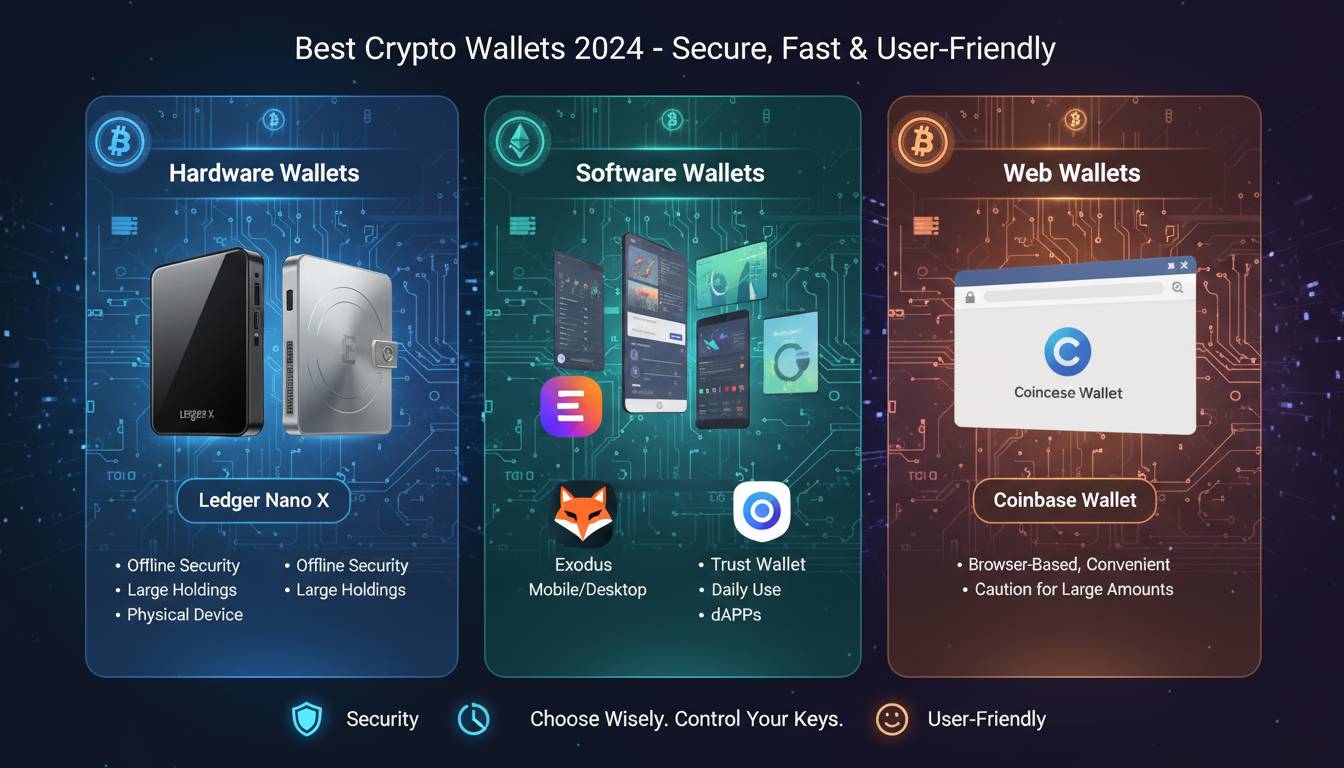
Hardware wallets—physical devices that store your private keys offline—provide the strongest protection against online attacks. Devices from companies like Ledger and Trezor cost $50-250 but prevent most remote theft attempts. For smaller holdings, reputable software wallets with strong security features suffice, but never store significant amounts on exchange wallets.
Account Protection
Enable two-factor authentication (2FA) on every exchange and wallet account. Use authenticator apps (Google Authenticator, Authy) rather than SMS-based 2FA, which attackers can bypass through SIM-swapping attacks. Create unique, complex passwords for each account and store them in a password manager.
Phishing Prevention
Always verify website URLs before entering credentials—scammers create domains with subtle misspellings. Never click links in unexpected emails or messages. Instead, navigate directly to exchange websites by typing addresses manually or using bookmarks you’ve created.
Private Key Protection
Your private keys control your cryptocurrency. Never share them with anyone, including support representatives from legitimate exchanges. Legitimate services never ask for your private keys or recovery phrases. Write recovery phrases on paper and store them securely; never store digital copies.
What To Do If You’ve Been Scammed
If you suspect you’ve become a victim of a crypto scam, take immediate action.
Document everything: Screenshot all communications, transactions, and account information. This evidence supports potential investigations.
Report to exchanges: If you know which exchange received your funds, contact their fraud department immediately. They may be able to freeze accounts if funds haven’t been withdrawn.
File regulatory complaints: Submit reports to the SEC (sec.gov/tcr), CFTC (cftc.gov/complaint), and FTC (ftc.gov/complaint). While recovery isn’t guaranteed, reports help build cases against scammers.
Contact local law enforcement: File reports with your local police department and the FBI Internet Crime Complaint Center . Provide all documentation and transaction details.
Alert the community: Sharing your experience on social media and crypto forums helps others avoid similar scams and may generate leads about the scammer’s identity.
Frequently Asked Questions
How do I know if a crypto project is legitimate?
Legitimate projects have verifiable teams, working products or clear technical documentation, transparent token distribution, active communities discussing real utility, and no history of regulatory warnings. If any of these elements are missing or concerning, proceed with extreme caution or avoid the investment entirely.
Are all cryptocurrency exchanges safe to use?
No. Even legitimate exchanges vary significantly in security practices and regulatory compliance. Use well-established exchanges that operate in the US and comply with local regulations. Research their security features, insurance policies, and track record before trusting them with funds.
Can I recover money lost to a crypto scam?
Recovery is difficult but sometimes possible, particularly if you act quickly and funds remain at identifiable exchanges. Report incidents immediately to exchanges and law enforcement. However, many scams use techniques that make追踪 extremely difficult, and complete recovery is rare.
What is the safest way for a beginner to buy cryptocurrency?
Start with well-established US-based exchanges like Coinbase, Kraken, or Gemini, which maintain regulatory compliance and strong security practices. Begin with small investments you’re comfortable losing entirely. Consider using a hardware wallet for any holdings you plan to hold long-term rather than actively trade.
Should I invest in any cryptocurrency that promises guaranteed returns?
No. All investments carry risk, and guaranteed returns are impossible in legitimate markets. Promises of guaranteed returns are the hallmark of Ponzi schemes and fraud. Any project making such claims should be avoided completely.
How can I verify if a cryptocurrency token isn’t a scam before buying?
Verify the team’s identity, read and understand the whitepaper, check how tokens are distributed through blockchain explorers, research community discussions for red flags, and confirm whether the project has any regulatory issues. If you cannot verify basic information or find significant concerns, don’t invest.